# Scratching Beneath the Surface: Cryo-EM Guides New Opioid Drug Design
**Author:** CryoSPARC Team
**Published:** June 16, 2026
**Category:** Discoveries
**Tags:** structural-biology, cryosparc, cryo-em, discoveries, sbdd, gpcr
**Summary:** Cryo-EM revealed the molecular basis of KOR signaling bias, enabling structure-based drug design of an anti-pruritic peptide with reduced side effects.
**Source:** https://cryosparc.com/blog/kor-sbdd
---
Patients with chronic kidney disease often rely on hemodialysis to perform the essential functions that failing kidneys no longer can. While this life-sustaining treatment removes excess fluids and waste products from the blood, it often comes with a difficult tradeoff. Many patients experience moderate-to-severe pruritus, a persistent, chronic itching sensation that can disrupt sleep, impair mental health, and significantly diminish quality of life.
For these patients, difelikefalin has offered much-needed relief. Approved by the FDA in 2021, this peptide therapeutic targets the κ-opioid receptor (KOR), a G protein-coupled receptor (GPCR) involved in regulating itch perception [1]. Yet, like many drugs acting on complex signaling systems, its benefits come with limitations. **While difelikefalin effectively suppresses itch, it activates not only the therapeutically beneficial G-protein pathway but also β-arrestin signaling, which has been associated with side effects such as sedation and anxiety** [2].
In other words, patients may find themselves exchanging one burden for another.
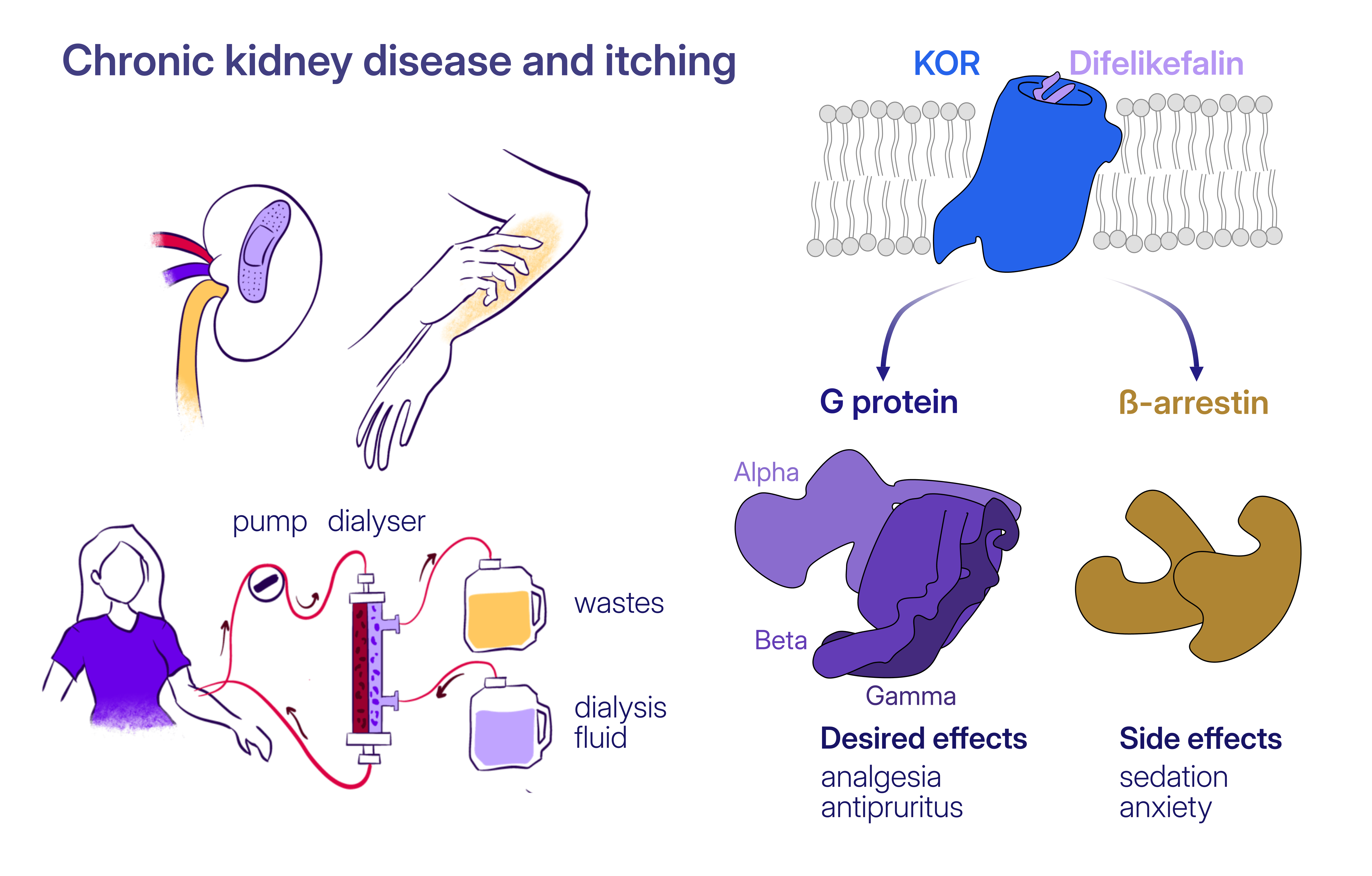
**How can we preserve the therapeutic benefits of KOR activation while avoiding the pathways responsible for unwanted side effects?** Answering this question requires understanding the molecular details of how difelikefalin interacts with its receptor, a challenge perfectly suited for structural biology and cryo-EM.
### Cryo-EM Reveals the Molecular Basis of KOR Activation
To obviate the need for safer opioid alternatives that retain therapeutic benefits while minimizing adverse effects, the authors of [a recent study published in *Nature Communications*](https://www.nature.com/articles/s41467-026-71455-3) reconstituted the difelikefalin-bound KOR–Gi complex and employed single-particle cryo-EM to uncover its structural details. Using [CryoSPARC](https://cryosparc.com/) for image processing and three-dimensional reconstruction, the researchers determined the architecture of the receptor in its active state, providing a view of how the therapeutic peptide engages KOR.
Their structural analysis identified a **key residue, Y320, located within the receptor's binding pocket**. This amino acid forms critical interactions with difelikefalin, **engaging the N-terminal D-Phe1 residue of difelikefalin** through a π–π interaction. A series of mutational studies confirmed that this residue is **also essential for modulating the balance between KOR-mediated G-protein activation and β-arrestin recruitment**. These findings transformed a structural observation into a mechanistic understanding of receptor function, revealing a potential strategy for designing safer KOR-targeting therapeutics.
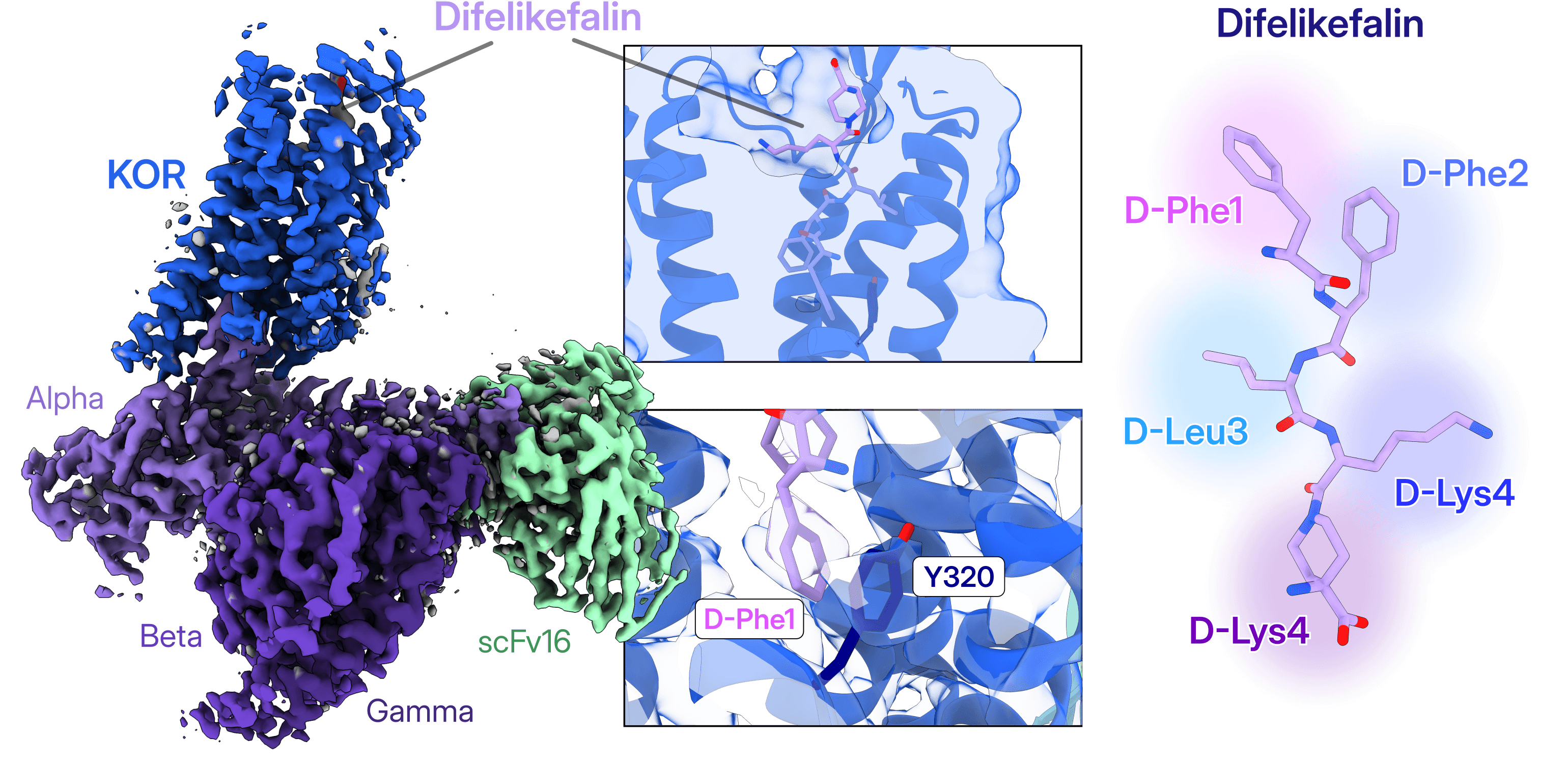
EMD-68217, PDB:22ES
### From Structural Insight to Drug Design: Engineering Beta01
Armed with a detailed structural blueprint, the researchers set out to redesign difelikefalin itself. Remarkably, **replacing this single D-Phe1 amino acid with β-phenylalanine produced a new peptide, beta01, with dramatically different signaling properties**.
Despite the minimal chemical change, beta01 behaved as a **strongly G protein-biased agonist**. In cellular and animal studies, it retained the antipruritic efficacy of difelikefalin while substantially reducing side effects such as sedation and anxiety.
To understand why such a subtle modification had such a profound effect, the team again turned to cryo-EM. Using [CryoSPARC](https://cryosparc.com/) to process the cryo-EM data, they determined the structure of the beta01-bound KOR–Gi complex and compared it with the original difelikefalin-bound receptor.
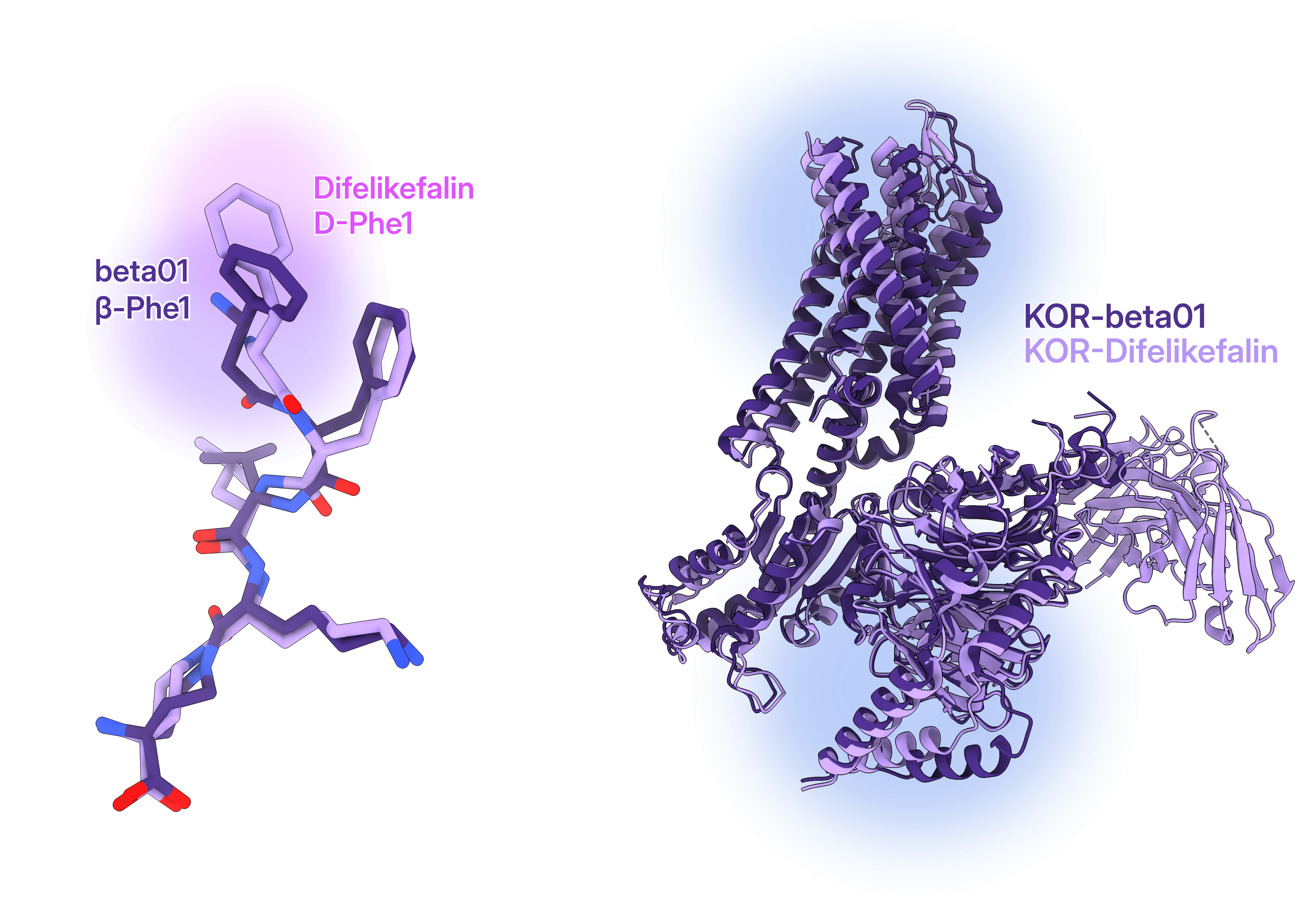
PDB:22ES (lilac) vs PDB:22EM (purple)
The comparison revealed that **beta01 induces a distinct network of conformational changes throughout the receptor**. Several key GPCR microswitches adopted different conformations relative to the difelikefalin-bound state. Together, these changes reshaped the intracellular face of KOR, creating a **receptor conformation that remained competent for G-protein coupling but appeared less favorable for β-arrestin engagement**.
The study did not stop at cryo-EM structures. Molecular dynamics simulations, NMR spectroscopy, and functional signaling assays provided complementary evidence that beta01 stabilizes a unique ensemble of receptor conformations.
### A Roadmap for Next-Generation GPCR Therapeutics
**The development of beta01 demonstrates the power of structure-guided drug design**. Rather than relying solely on trial-and-error screening, the researchers used cryo-EM to identify the molecular interactions responsible for signaling bias, engineered a targeted modification, and validated its effects experimentally.
More broadly, **[this study](https://www.nature.com/articles/s41467-026-71455-3) illustrates how modern cryo-EM workflows can accelerate the journey from molecular understanding to therapeutic innovation**. By revealing how small changes in ligand structure reshape receptor signaling, structural biology provides a rational framework for designing safer and more effective medicines.
#### References
- Li, X., Wan, H., Dong, P., Wang, B., Zhang, L., Hu, Q., ... & Tao, W. (2020). Discovery of SHR0687, a highly potent and peripheral nervous system-restricted KOR agonist. ACS Medicinal Chemistry Letters, 11(11), 2151-2155.
- Wala, K., & Szepietowski, J. C. (2022). Difelikefalin in the treatment of chronic kidney disease-associated pruritus: a systematic review. Pharmaceuticals, 15(8), 934.