# The Pain Paradox: Activating TRPV1 to Silence Its Response
**Author:** CryoSPARC Team
**Published:** September 1, 2026
**Category:** Discoveries
**Tags:** structural-biology, cryosparc, cryo-em, discoveries, sbdd
**Summary:** Combining rational drug design, functional studies, and cryo-EM, researchers characterize a selective TRPV1 agonist that promotes desensitization and prolonged pain relief.
**Source:** https://cryosparc.com/blog/trpv1-msp20
---
**Do we really need to feel pain?** Usually, yes. Pain warns us of potentially damaging stimuli, but what happens when pain itself becomes persistent? One of the molecular sensors involved in this response, TRPV1, offers an intriguing possibility: **activate it for long enough, and the pain-sensing channel becomes less responsive.**
The transient receptor potential vanilloid 1 (TRPV1) is a nociceptive ion channel that activates by heat (>42 °C), low pH, inflammatory mediators, and chemical agonists [1]. When activated, TRPV1 opens and allows calcium and other positively charged ions into sensory neurons, contributing to the signaling that ultimately produces the sensation of pain.
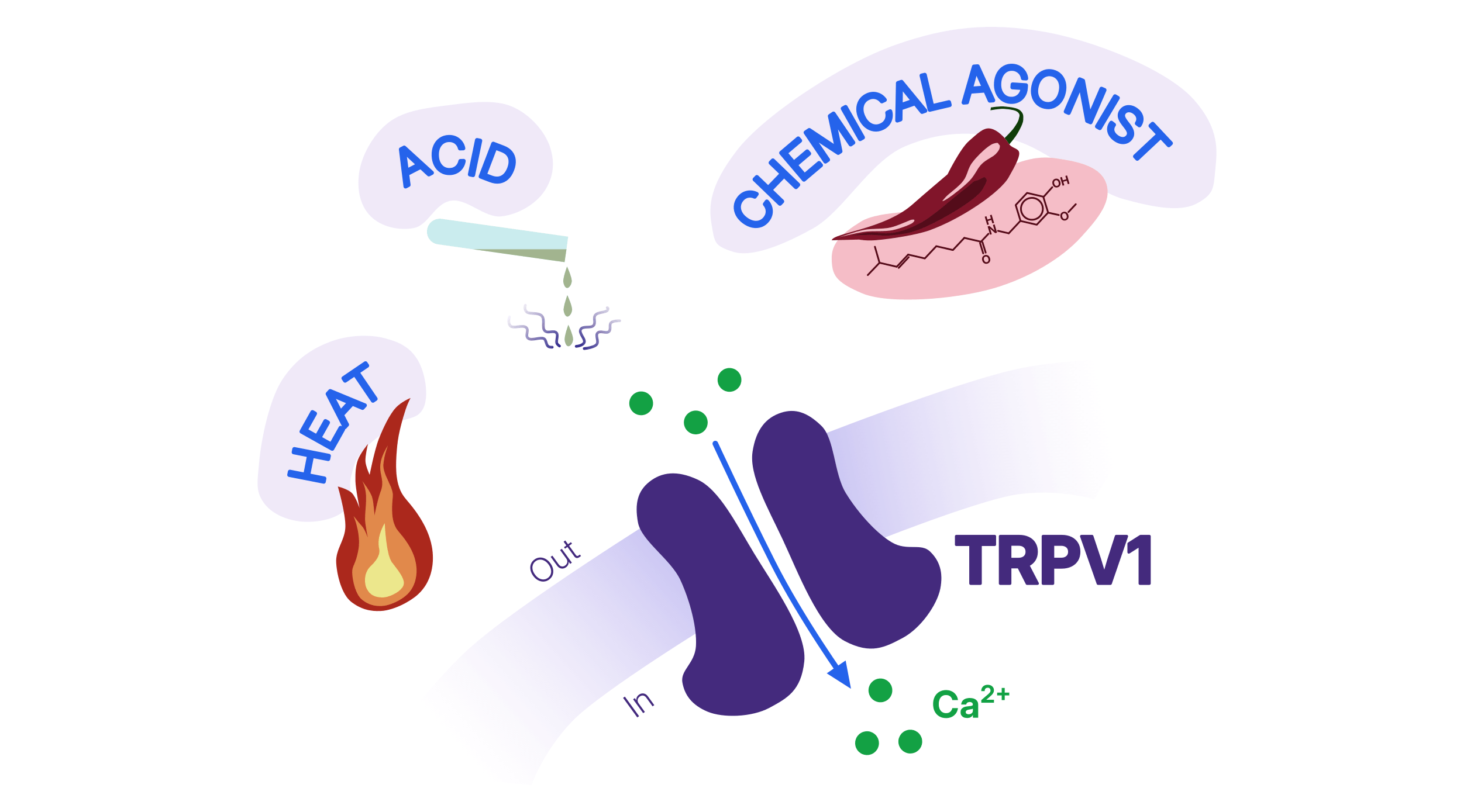
This protein has an interesting peculiarity: **just as we can progressively get used to particularly spicy food, TRPV1 becomes desensitized following prolonged or repeated exposure to chemical agonists** [2]. In fact, we can develop tolerance to spicy food partly thanks to TRPV1 desensitization.
What if the pain itself is the problem, as in inflammatory and neuropathic pain? **Why not exploit this desensitization mechanism?** Capsaicin, the compound responsible for the heat of chili peppers, activates TRPV1 and is already used today as a treatment for certain types of pain [3].
Here, we present how [a collaborative research effort](https://www.nature.com/articles/s41467-026-74972-3) leveraged a combination of *in vitro*, *in/ex vivo*, and cryo-EM studies to support the **rational design of a new capsaicin-inspired TRPV1 agonist, revealing how its interaction with the channel promotes a desensitized state with potential implications for pain treatment.**
### From Capsaicin to MSP20
As mentioned above, capsaicin initially activates TRPV1, causing burning and pain sensation, but prolonged activation leads to desensitization, which is what makes TRPV1 agonists therapeutically interesting. [In this recent *Nature Communications* publication](https://www.nature.com/articles/s41467-026-74972-3), the authors used rational drug design to identify structural features that promote ligand-channel interactions and subsequently synthesized a new class of TRPV1 agonists inspired by capsaicin.
**After thorough rational drug design, this study explores the characteristics of the selected most promising compound, MSP20, through *in vitro*, *in vivo*, and *ex vivo* experiments.** Calcium uptake measurements identified MSP20 as a potent and selective TRPV1 agonist, while prolonged exposure strongly reduced subsequent TRPV1 responses, an early indication that MSP20 could promote channel desensitization.
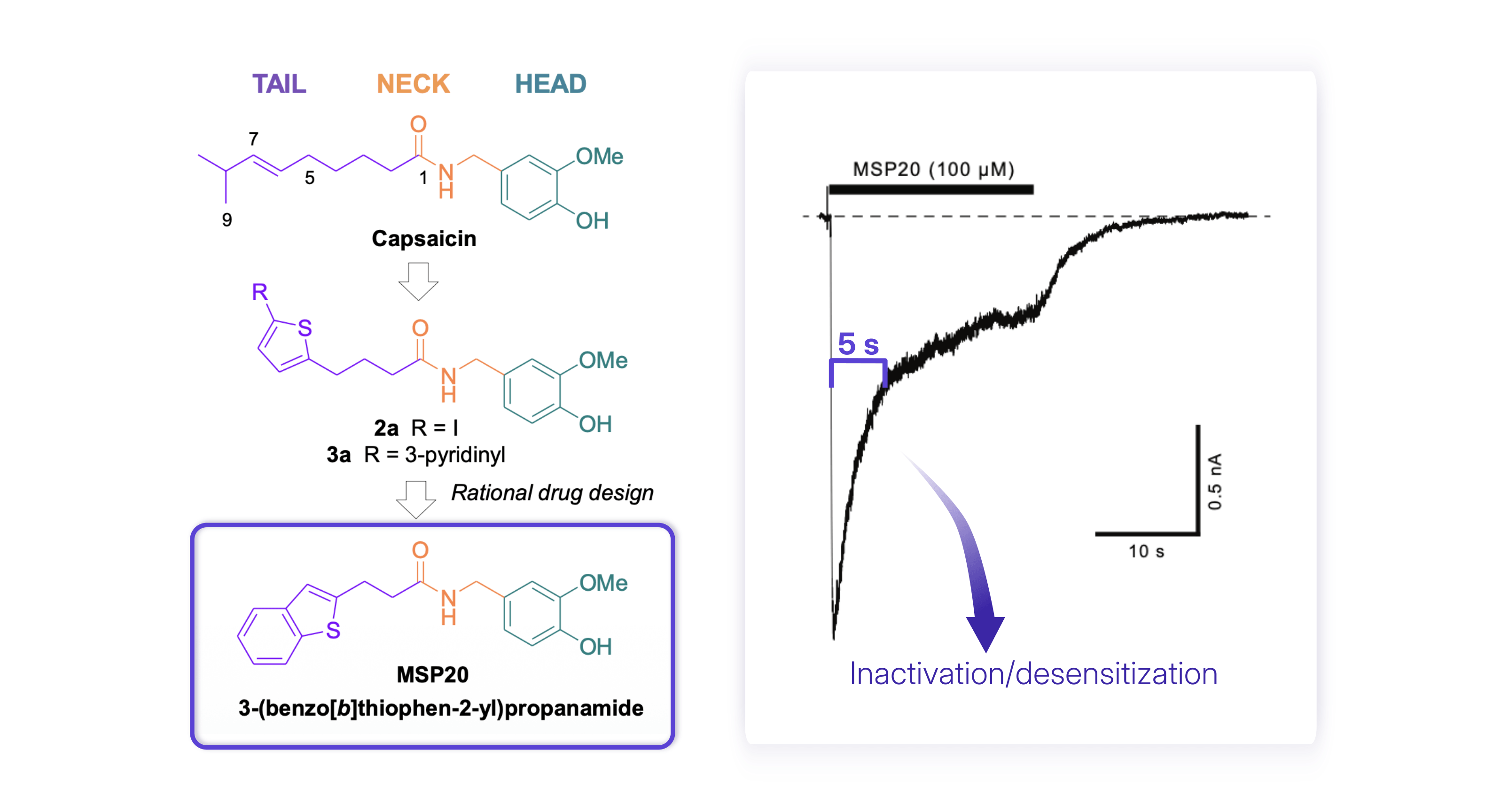
Chemical design to obtain MSP20 through rational drug design (left); representative current trace illustrating pronounced desensitization of human TRPV1 in response to a 20-second application of MSP20 (100 uM) (right). Figure adapted from Figures 1 and 7 in [Neuberger et al., 2026](https://www.nature.com/articles/s41467-026-74972-3).
In mice, MSP20 reduced pain responses and tactile allodynia in a neuropathic pain model. **Most strikingly, the effect outlasted the treatment itself:** reduced mechanical hypersensitivity remained detectable for several days after MSP20 administration stopped, without detectable changes in body temperature under the conditions tested.
### Finding More Good Particles: Iterative Processing of TRPV1-MSP20
**With the functional experiments showing that MSP20 activates and subsequently desensitizes TRPV1, the next question was structural: how does MSP20 interact with the channel, and what conformation does it stabilize?**
> *"We confirmed the time scale of this inactivation/desensitization is about 5 s (Fig. 7). The time scale for making cryo-EM samples using Vitrobot is about 1 min, meaning that most of our sample on the grid should be in inactivated/desensitized state."*
>
> *- Dr. Alexander I. Sobolevsky, Professor of Biochemistry and Molecular Biophysics, Columbia University (corresponding author)*
**Following purification, human TRPV1 was incubated with MSP20 and analyzed by single-particle cryo-EM, ultimately yielding a 2.6 Å reconstruction of the TRPV1-MSP20 complex.**
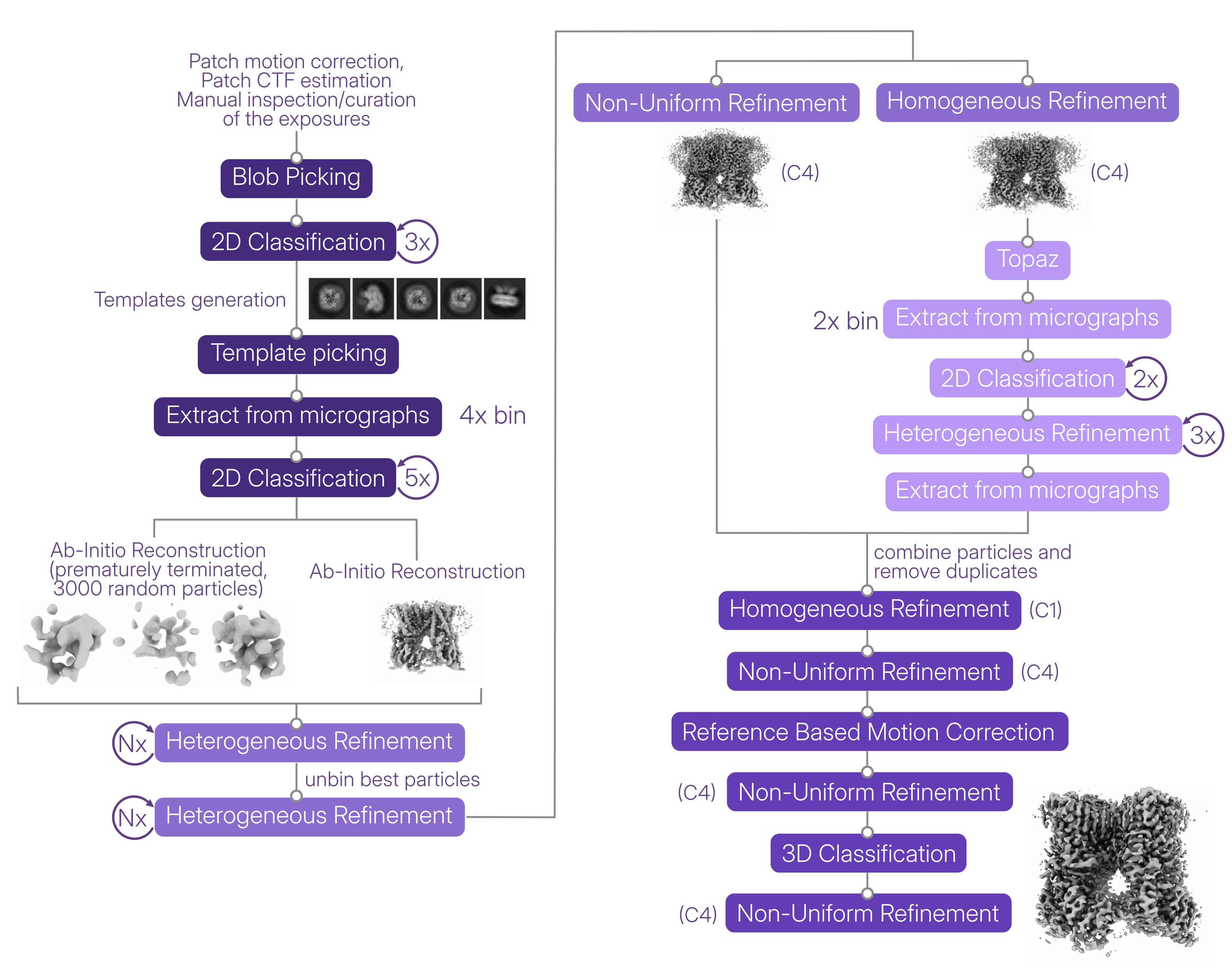
Data processing scheme adapted from [Neuberger et al., 2026](https://www.nature.com/articles/s41467-026-74972-3). The final reconstruction was obtained by further rescaling the map from the final Non-Uniform Refinement in ChimeraX using EMD-29983 as a reference, correcting the pixel size (0.856 to 0.83), and the final FSC calculation in CryoSPARC yielded a resolution of 2.6 Å.
Data processing in [CryoSPARC](https://cryosparc.com/) followed an iterative strategy aimed at progressively cleaning the particle stack while recovering as many high-quality TRPV1 particles as possible. Initial [Blob Picking](https://guide.cryosparc.com/processing-data/all-job-types-in-cryosparc/particle-picking/job-blob-picker) and [2D Classification](https://guide.cryosparc.com/processing-data/all-job-types-in-cryosparc/particle-curation/job-2d-classification) generated templates for subsequent [Template Picking](https://guide.cryosparc.com/processing-data/all-job-types-in-cryosparc/particle-picking/job-template-picker). The newly picked particles were then cleaned through multiple rounds of 2D Classification before moving into 3D particle curation.
The authors used [Heterogeneous Refinement](https://guide.cryosparc.com/processing-data/all-job-types-in-cryosparc/3d-refinement/job-heterogeneous-refinement) for decoy classification, in which the junk volumes were generated by prematurely terminating a three-class [Ab-Initio Reconstruction](https://guide.cryosparc.com/processing-data/all-job-types-in-cryosparc/3d-reconstruction/job-ab-initio-reconstruction) job.
> *"Our typical particle clean-up pipeline includes rounds of Heterogeneous Refinement and Homogeneous Refinement of the good class, which we repeat till the percentage of particles in the good class in Heterogeneous Refinement reached 80-90%."*
>
> *- Dr. Sobolevsky (corresponding author)*
Rather than stopping once a clean particle stack had been obtained, the authors **used these selected particles to train [Topaz](https://guide.cryosparc.com/processing-data/all-job-types-in-cryosparc/deep-picking/topaz) and return to the particle-picking stage**. The additional particles recovered with Topaz were taken through the same iterative cleanup strategy and combined with the previously selected particles after duplicate removal.
[**Reference Based Motion Correction**](https://guide.cryosparc.com/processing-data/all-job-types-in-cryosparc/motion-correction/job-reference-based-motion-correction-beta) **was implemented using the high-quality reference volume obtained after these data-processing steps. C4 symmetry was introduced only once the reconstruction had reached sufficient resolution to confidently establish the fourfold symmetry of the TRPV1 channel**, avoiding the imposition of symmetry during the earlier stages of particle cleanup. The final processing strategy yielded a **2.68 Å reconstruction, reported at 2.60 Å after pixel-size rescaling**, providing the level of detail needed to examine MSP20 binding and the conformation of the channel.
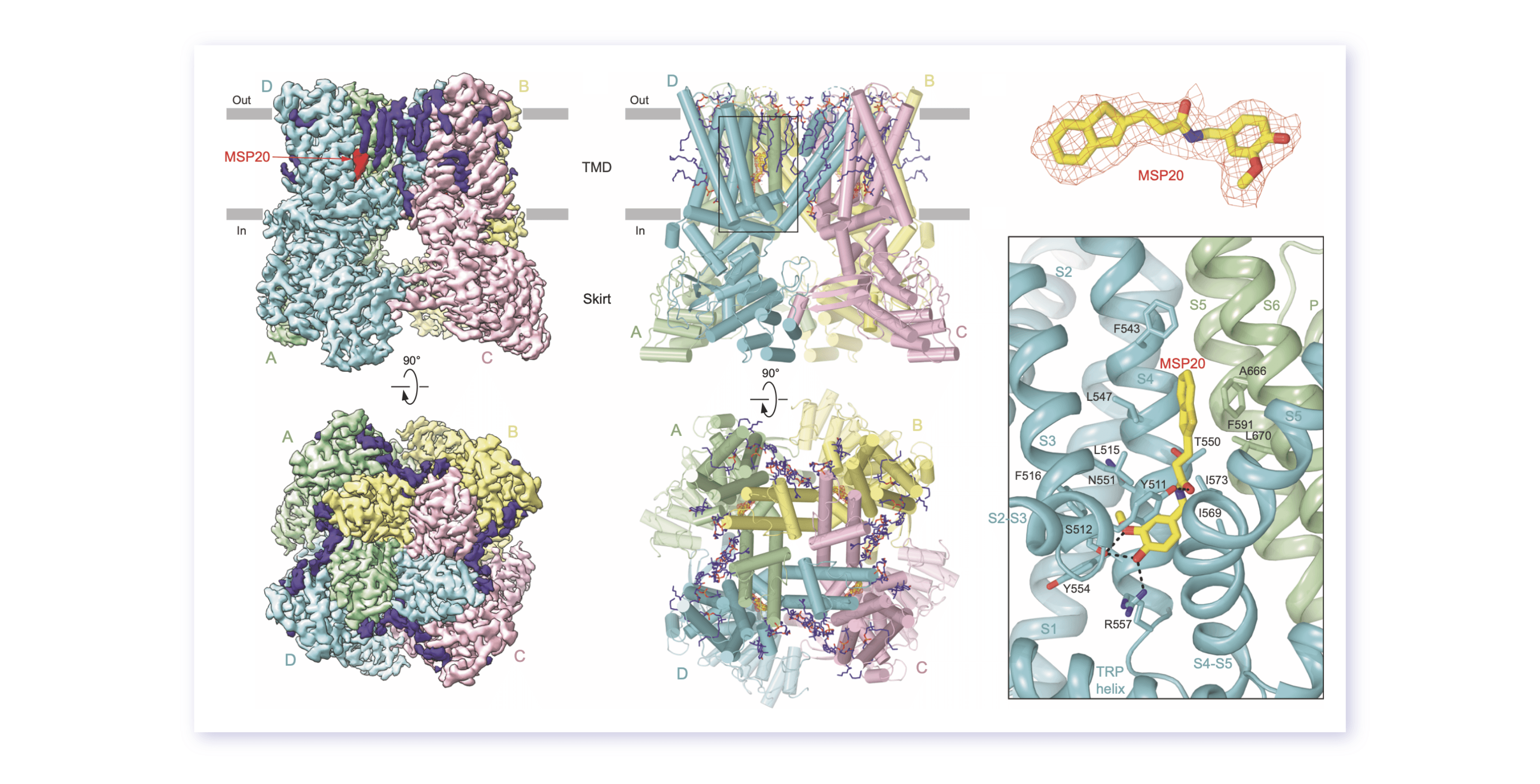
Cryo-EM map (left) and atomic model (center) of MSP20-bound TRPV1; MSP20 binding to the TRPV1 vanilloid-binding pocket (right). Figure adapted from [Neuberger et al., 2026](https://www.nature.com/articles/s41467-026-74972-3).
### Agonist Bound, Pore Closed: Capturing Desensitized TRPV1
**The cryo-EM structure indeed showed one MSP20 molecule in the vanilloid-binding pocket of each TRPV1 subunit, but the channel pore was closed.** Rather than simply resembling the apo closed state, however, the structure combined features that distinguished it from both previously characterized closed and open conformations.
> *"We confirmed the [deactivated] state by solving the structure of TRPV1-MSP20 complex, which has cumulative features of desensitized/inactivated state, which are different from the set of features describing the apo closed or open states. For example, the pore of the channel is shut for permeation and lipid near F582 is present (different from the open state), while the C-terminus adopts alpha-helical conformation (different from the closed state)."*
>
> *- Dr. Sobolevsky (corresponding author)*
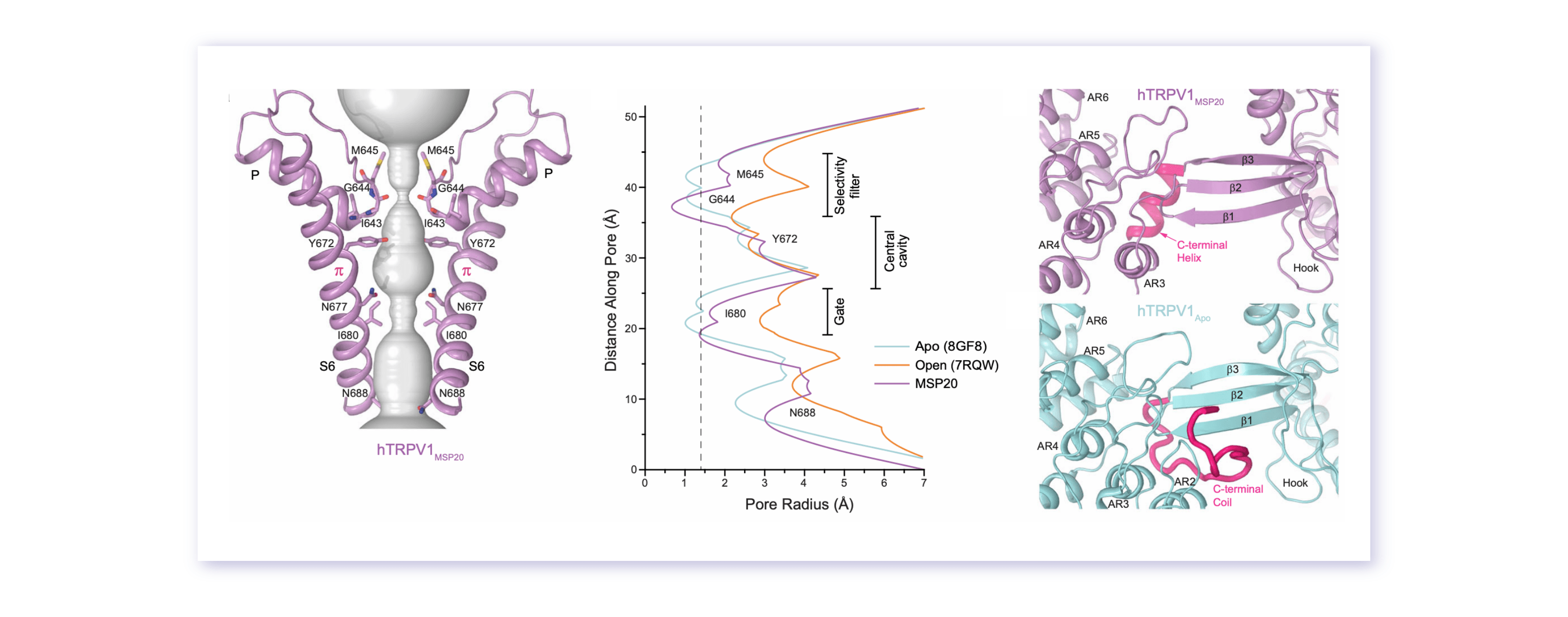
Pore-forming domain of MSP20-bound TRPV1 (left), comparison of pore radii between apo, open and MSP-bound TRPV1 calculated using HOLE (center), and different conformations of the TRPV1 C-terminus between MSP20-bound and apo TRPV1 structures (right). Figure adapted from [Neuberger et al., 2026](https://www.nature.com/articles/s41467-026-74972-3).
The functional data complemented this structural picture. Upon MSP20 application, TRPV1 currents rapidly increased before declining markedly during continued exposure, consistent with activation followed by desensitization. The structure also revealed how MSP20 occupies the vanilloid-binding site and interacts with the channel as anticipated during its rational design.
> *"... MSP20 is bound to the vanilloid site, like other TRPV1 agonists (e.g., capsaicin) and all molecular interactions are exactly like they were predicted during the original design of the set of these molecules, which aimed at high affinity and specificity TRPV1 agonists"* [4].
>
> *- Dr. Sobolevsky (corresponding author)*
Interestingly, MSP20 was less potent than capsaicin while remaining highly selective for TRPV1. Beyond explaining the properties of MSP20 itself, the structure therefore provides a starting point for designing compounds that preferentially stabilize the desensitized state.
> *"Now that we have precise description of MSP20 interactions with the inactivated/desensitized state of TRPV1 (Figs. 6-7), one can design derivatives of MSP20 that would favor the inactivated/desensitized state over closed/open and have better analgesic properties."*
>
> *- Dr. Sobolevsky (corresponding author)*
The study therefore comes back to the paradox at the heart of TRPV1 pharmacology: **reducing pain does not necessarily require simply blocking a pain sensor.** By combining rational drug design, functional characterization, and cryo-EM, the authors show how an agonist can activate TRPV1 and promote its subsequent desensitization, while providing a structural framework for exploring this mechanism in the development of future analgesics.
#### References
- Nilius, B., Vennekens, R., & Owsianik, G. (2008). Vanilloid transient receptor potential cation channels: an overview. Current Pharmaceutical Design, 14(1), 18-31. doi: 10.2174/138161208783330763
- Sanz-Salvador, L., Andres-Borderia, A., Ferrer-Montiel, A., & Planells-Cases, R. (2012). Agonist- and Ca2+-dependent desensitization of TRPV1 channel targets the receptor to lysosomes for degradation. Journal of Biological Chemistry, 287(23), 19462-19471. doi: 10.1074/jbc.M111.289751
- Yang, F., & Zheng, J. (2017). Understand spiciness: mechanism of TRPV1 channel activation by capsaicin. Protein & Cell, 8, 169-177. doi: 10.1007/s13238-016-0353-7
- Romeo, I., Brizzi, A., Pessina, F., Ambrosio, F. A., Aiello, F., Belardo, C., et al. (2023). In silico-guided rational drug design and synthesis of novel 4-(thiophen-2-yl) butanamides as potent and selective TRPV1 agonists. Journal of Medicinal Chemistry, 66(10), 6994-7015. doi: 10.1021/acs.jmedchem.3c00447