Digging Deeper: Why refinements can be robust to the presence of junk particles
The effect of parameter settings on 3D refinement: Minimize over per-particle scale, Adaptive marginalization, Non-uniform regularization, and Masking
In the recently published Case Study: Discrete heterogeneity in a sample of acetogenin-bound Complex I (EMPIAR-10927), mitochondrial Complex I was reconstructed in CryoSPARC using several different processing strategies. One interesting observation is that the initial refinement (using 90,066 particles), and the final reconstruction (using only 19,090 particles) were comparable in terms of nominal resolution and map quality.
In this post, we will explore how these two reconstructions in the presented case study can appear so similar when one refinement contains many particles that are later shown to belong to other complexes, or to junk classes.
The answer lies in how 3D Refinement determines the contribution of each particle to the final map.
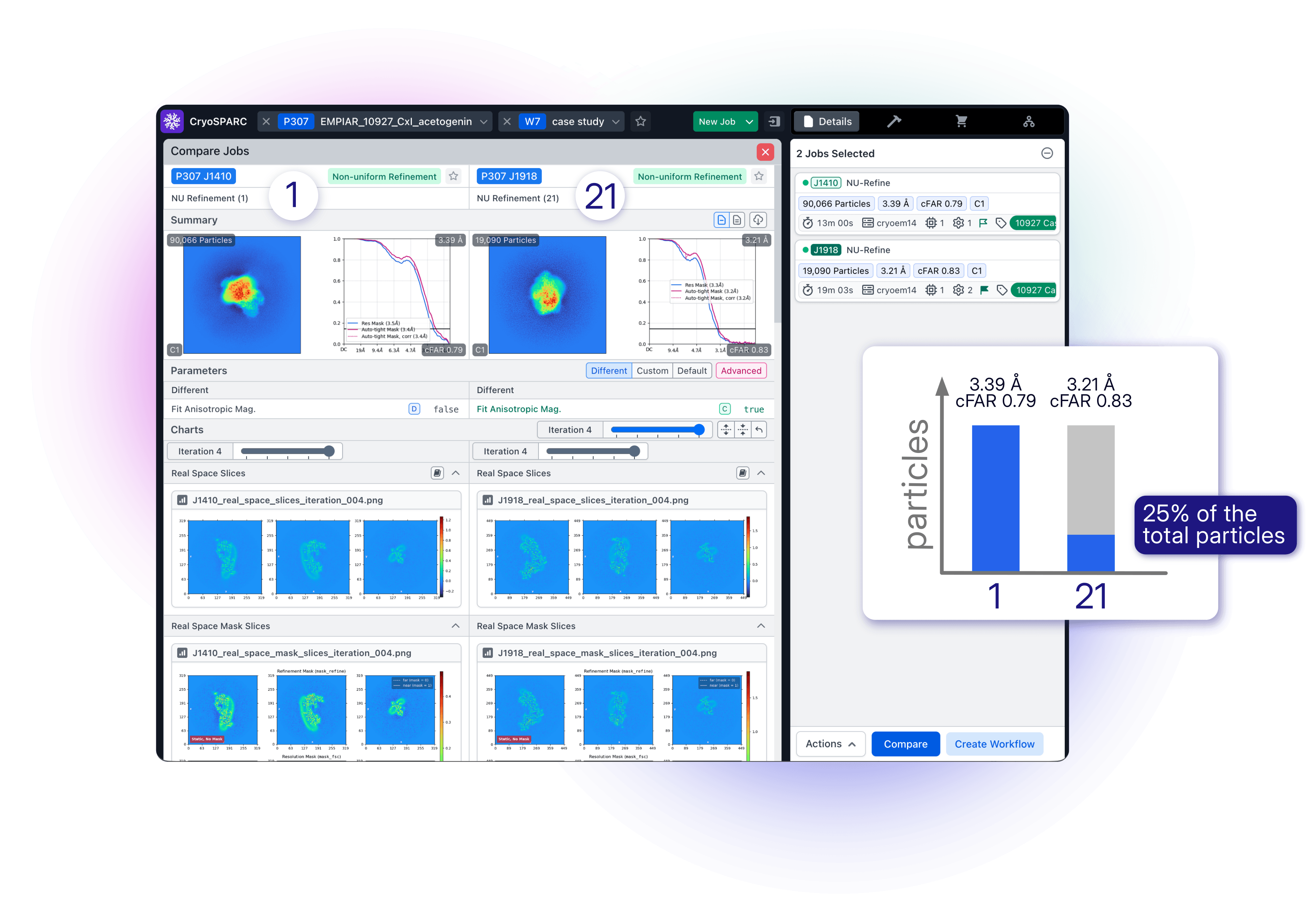 Comparison of Non-Uniform Refinement (1) and Non-Uniform Refinement (21) from the Case Study: Discrete heterogeneity in a sample of Acetogenin-bound complex I (EMPIAR 10927) using Comparison View. Refinement (21) contains only 25% of the original particle stack used for Refinement (1).
How Refinement Works
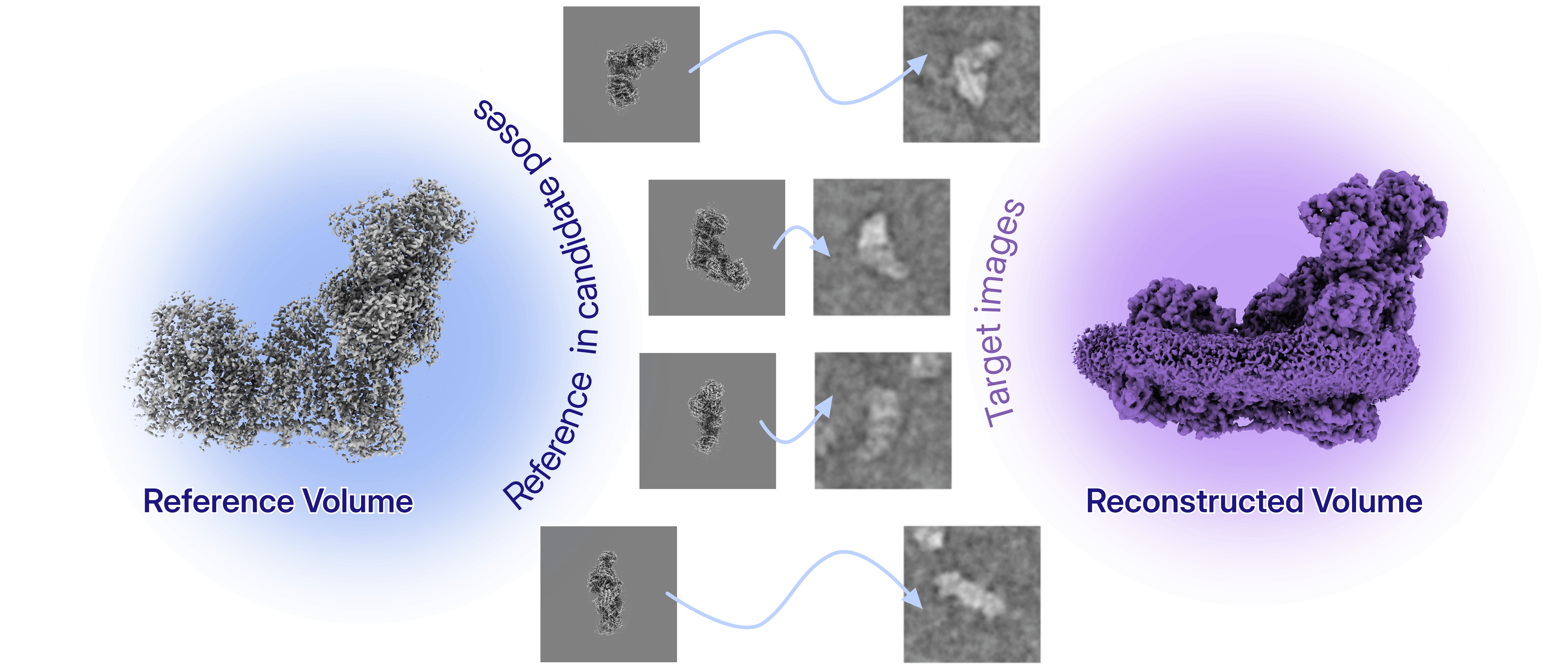
3D Refinement is explained in depth in the CryoSPARC Guide. At its core, cryo-EM refinement assigns a pose (orientation and position) to each particle image by comparing it to projections of a reference volume. The aligned particles are then backprojected to generate an updated 3D reconstruction, and the process is repeated iteratively.
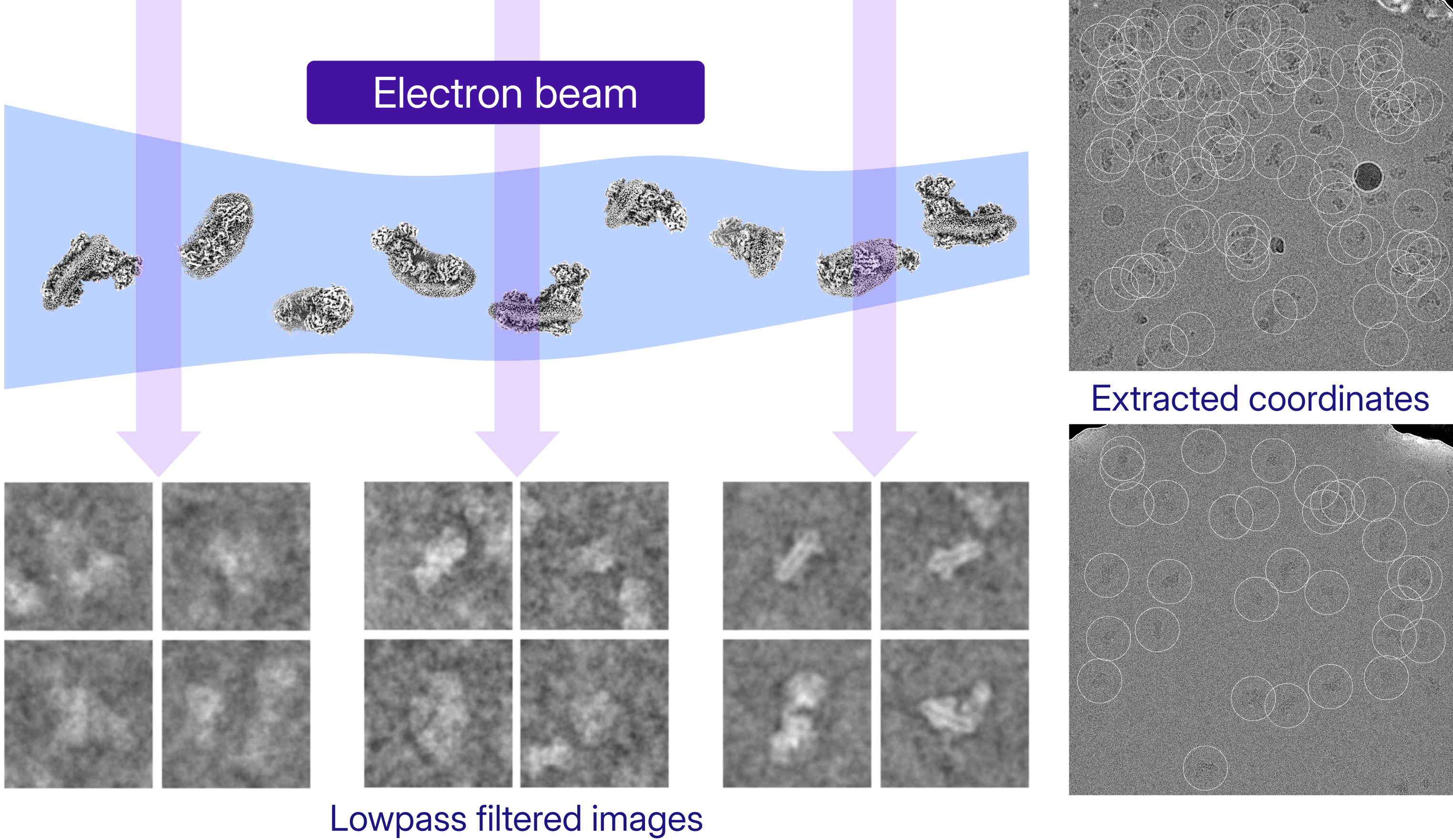
Then there is the concept of per-particle scale, a metric which accounts for the values in the local greyscale of the image compared to the greyscale of the volume. This is a multiplicative amplitude correction estimated for each particle image: not all particle images have the same overall contrast because of differences in ice thickness, local environment, beam-induced motion, detector response, or imaging conditions that can cause some particles to appear stronger or weaker than others. When each raw image is multiplied by its per-particle scale, the images are all on the same grayscale and can be backprojected to produce the volume.
Map quality therefore depends not only on the number of particles, but also on how confidently those particles can be aligned and how strongly they are allowed to contribute to the reconstruction.
Refinement Parameters and Their Effect on the Final Map
Several refinement settings determine how particles contribute to the reconstruction and how robustly the algorithm deals with heterogeneity and imperfect data.
- Minimize over per-particle scale: This parameter calculates the particles’ optimal scale at each iteration, and adjusts the relative contribution of individual particles based on how well they agree with the reference volume after alignment. Particles that agree well with the reference volume are up-weighted, while poorly matching particles are down-weighted. In the dataset of the discussed case study, particles from other complexes and junk classes clustered at lower per-particle scale values in respect to the target particles, possibly contributing more weakly to the refinement of Complex I.
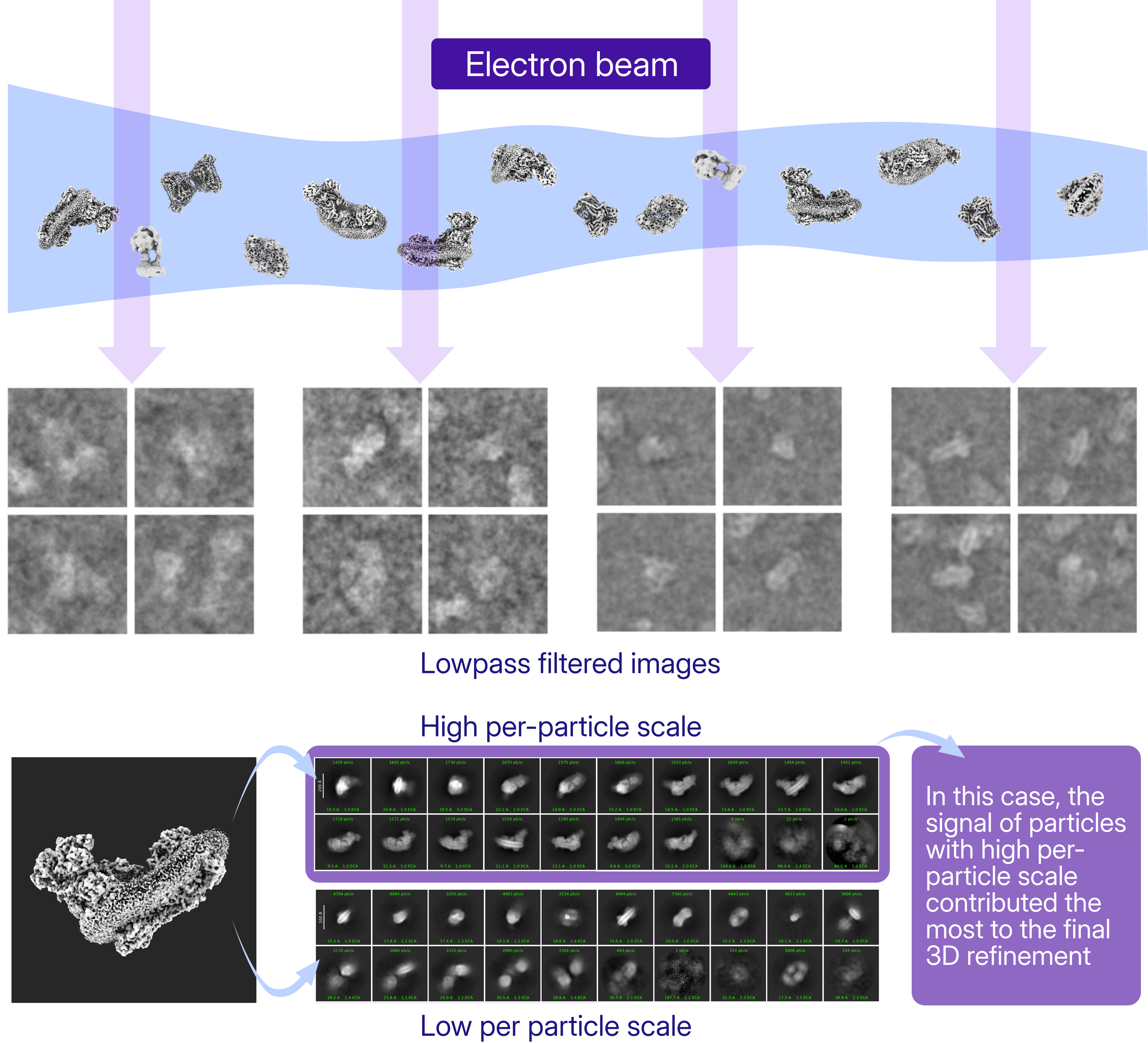
Per-particle scale reflects more than particle quality: it can also reveal particles that are inconsistent with the target structure, including contaminants, junk classes, or alternative molecular species.
- Adaptive marginalization: The pose searches of the particles images relative to the reference volume is already computationally challenging, that’s why CryoSPARC uses the specialized algorithm called “branch and bound” to perform a hierarchical search for particle poses. Additionally, when a particle has low contrast or does not match the reference well, its orientation may be uncertain. Rather than forcing a single pose assignment, refinement can distribute its contribution across several plausible poses, reducing the impact of misaligned particles.
- Masking: Masks focus alignment on regions of interest while excluding surrounding density such as detergent micelles, neighboring particles, or flexible regions. By emphasizing the most reliable features of Complex I, masking improves pose estimation and limits the influence of unrelated density.
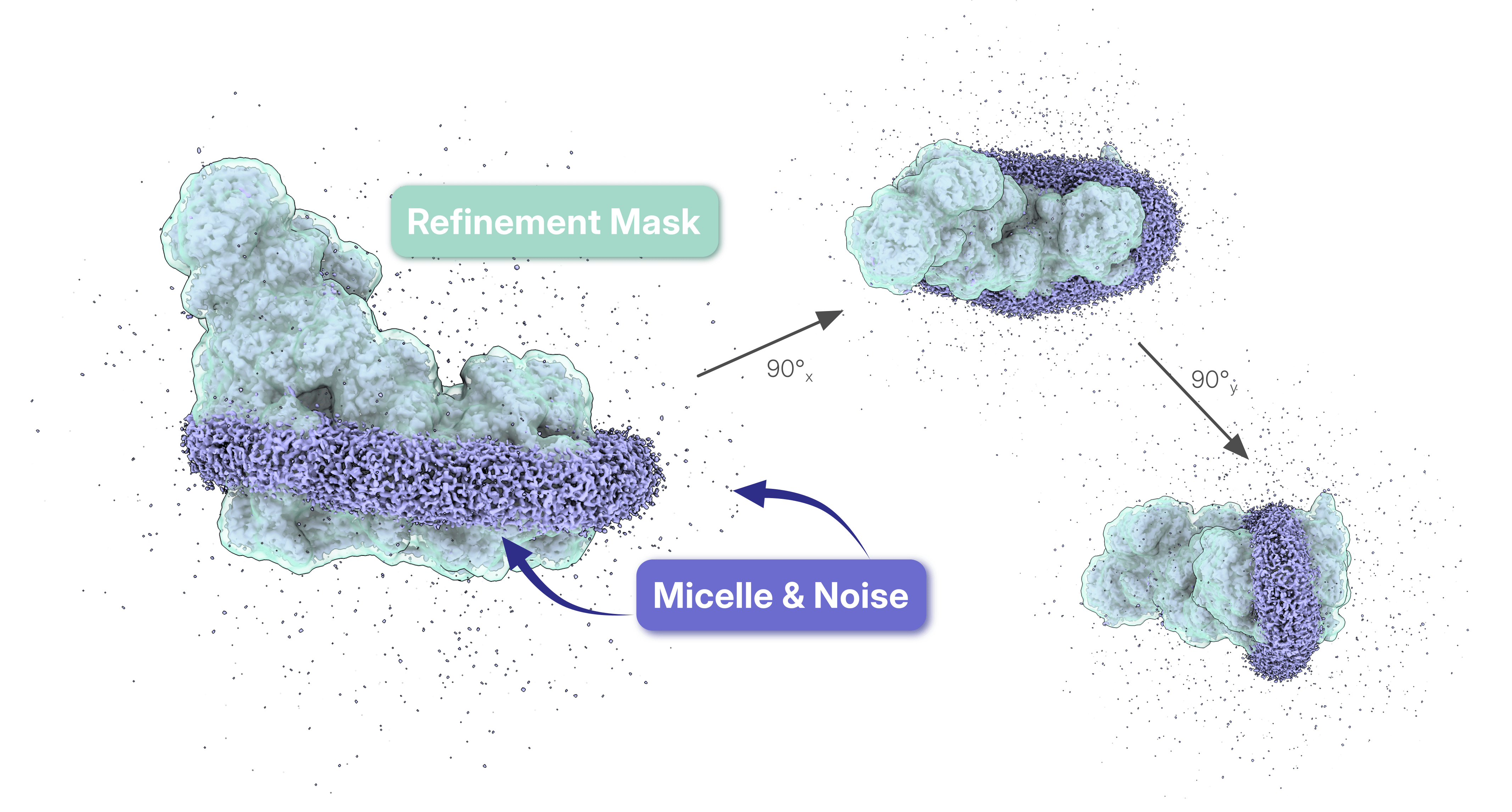
- Non-Uniform regularization (or Non-uniform refine enable): One of the most powerful features of CryoSPARC's Non-Uniform Refinement is its ability to treat different regions of the map differently according to their local signal quality. Different regions of a map contain different amounts of signal. Non-Uniform Refinement suppresses noisy or poorly ordered regions while preserving well-resolved features. This reduces overfitting and allows alignment to be driven by the most consistent structural information, even when the particle stack contains substantial heterogeneity.
Comparison of Refinement Parameters in the Case Study
To test the effect of the above parameters on the map quality in the Non-Uniform Refinements (1) and (21) we ran a set of additional jobs, whose the results are shown below. When the discussed parameters were stripped down and we ran only the base refinements for the considered particle stacks, the resulting map qualities differed considerably, and the influence of particles belonging to junk and other protein complexes caused the final map obtained from the initial particle stack to be of poorer quality (cFAR 0.36, and very little side chain definition). Separately enabling Non-Uniform regularization, minimize over per-particle scale, dynamic masking, or Adaptive marginalization improves the cFAR and map quality for both particle sets.
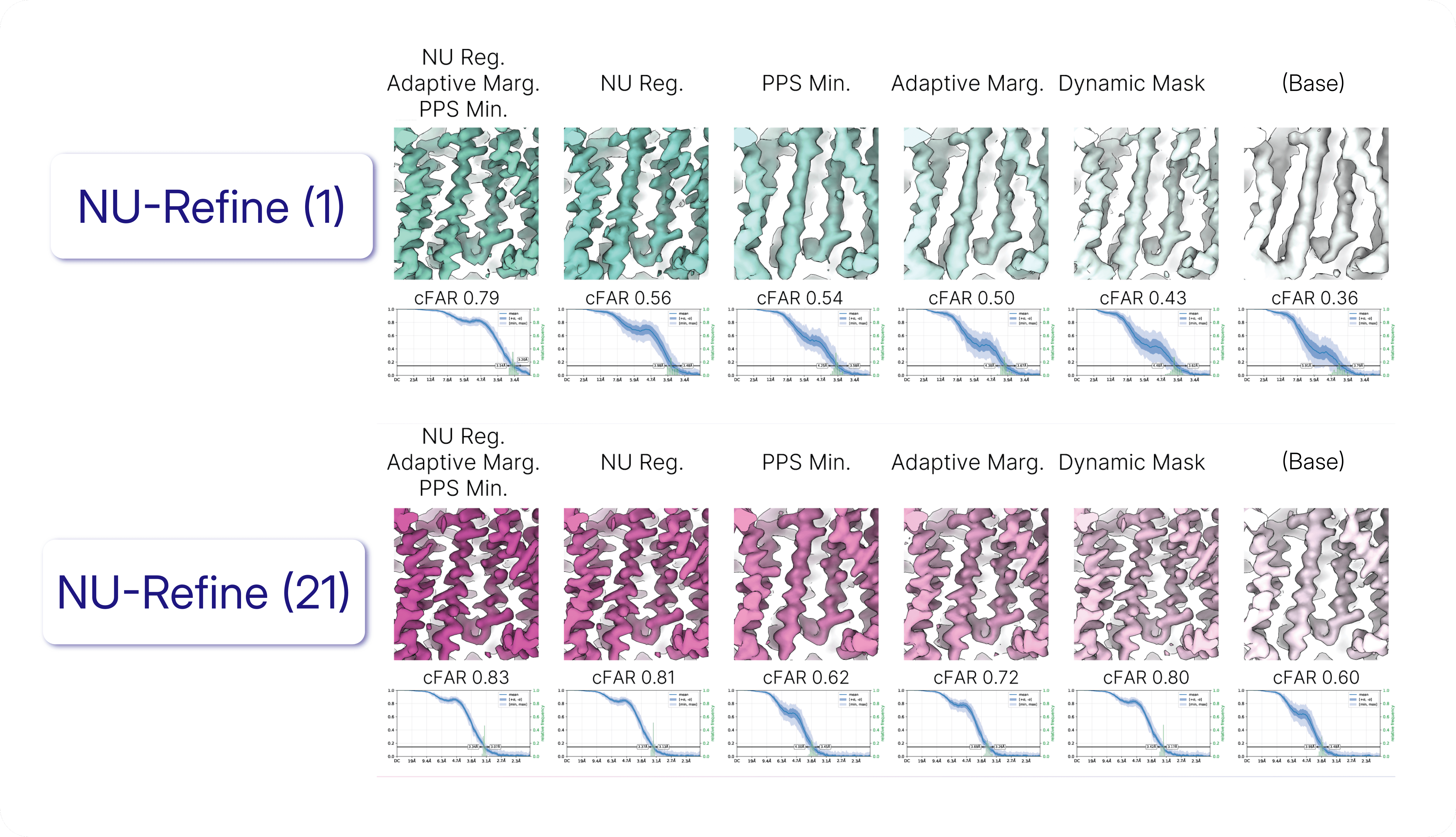
Enabling Non-Uniform regularization alone substantially improved both map quality and cFAR for the initial and final particle stacks (Non-Uniform Refinements (1) and (21), respectively). For the cleaner final particle stack, the resulting reconstruction was nearly indistinguishable from that obtained when Adaptive marginalization and minimize over per-particle scale were also enabled. In contrast, for the more heterogeneous initial particle stack, Non-Uniform regularization alone was insufficient to achieve the same map quality, indicating that enabling Adaptive marginalization and minimize over per-particle scale was required to reduce the influence of inconsistent particles.
This became even more apparent when only Adaptive Marginalization was enabled. Under these conditions, the two Non-Uniform refinements produced markedly different maps, demonstrating that accounting for pose uncertainty alone could not compensate for the heterogeneous particles present in the initial stack.
Dynamic masking and Non-Uniform regularization are strategies that mitigate a similar problem with different approaches: both focus the refinement pose assignment on the well-ordered regions of the map. In the cleaner particle stack, either approach was sufficient to produce comparable map quality and cFAR. In the heterogeneous initial particle stack, however, Dynamic masking alone could not compensate for the additional particles, potentially because Non-Uniform regularization limits the ability for outlier particles to produce overfitting artefacts in the micelle region.
These observations are specific to the Complex I dataset examined in this case study, but they illustrate an important point: different refinement parameters respond differently to different types of heterogeneity. Exploring alternative refinement settings can therefore provide valuable insight into the composition of a particle stack and help determine which strategy is most appropriate for the biological question being addressed.
Resolution Is Not the Whole Story
In this case study, refinement produced a convincing reconstruction even though the initial particle stack contained substantial heterogeneity. The selected refinement settings automatically reduced the influence of poorly matching particles and focused the reconstruction on the most self-consistent signal, explaining why the 90,066 particles refinement appeared surprisingly similar to the final reconstruction obtained from just 19,090 particles.
However, further cleaning of the particle stack remained essential to isolate a single structural state and uncover the additional complexes hidden in the original dataset. This serves as a useful reminder for users: a high-quality map does not necessarily indicate a homogeneous particle stack. When interpreting your own data, it is worth considering not only the appearance of the final reconstruction, but also how refinement settings may be weighting, suppressing, or masking underlying heterogeneity.