Overcoming Preferred Orientation with Automated Workflows in CryoSPARC™
Preferred orientation is a persistent challenge in cryo-EM, but what can be done during data processing? Explore how advanced automated workflows in CryoSPARC can mitigate the effects of preferred orientation, improving map quality and interpretability across nine challenging datasets.
Preferred orientation is a familiar challenge in cryo-EM, but can smarter data processing help overcome it?
As one of the major challenges in cryo-EM data processing, it often compromises map quality and interpretability, particularly for small targets relevant to drug discovery.
Processing datasets affected by preferred orientation can require extensive manual intervention, slowing down the path from data collection to an interpretable structure. With automated data processing becoming more and more possible and yielding results equivalent or better than manual processing (see Workflow v1), we wanted to explore whether automation could also tackle the challenge of severe preferred orientation.
In this blog post, we walk through the Advanced automated data processing: a case study using CAK, where we put automated processing to the test on nine drug-bound CDK-activating kinase (CAK) datasets.
A New Challenge: Handling Preferred Orientation
CAK (CDK-activating kinase) is a critical regulator of cell division and growth, making it an important target for cancer and antiviral therapies. Its relatively small size (~80 kDa), combined with severe preferred particle orientation in cryo-EM datasets, makes CAK not only medically relevant but also particularly challenging for data processing.
This combination of biological relevance and processing challenges made CAK an ideal test case to push the limits of automated data processing. We developed an advanced automated workflow (Workflow v2) and put it to the test on nine EMPIAR datasets, covering CAK in its apo state, bound to a nucleotide analog, and in complex with seven distinct inhibitors.
Preferred orientation can make it difficult to obtain high-quality, interpretable cryo-EM maps, even when the reported nominal resolution is high. An uneven distribution of particle orientations can lead to anisotropic reconstructions and characteristic map artifacts, such as streaking, that compromise map interpretability. In some cases, the nominal resolution may appear better than the actual quality of the reconstruction would suggest, particularly when overfitting is involved.
The Workflow v2 was developed to better handle these challenging datasets, introducing processing strategies that mitigated the effects of preferred orientation and improved map quality and interpretability.
Picking More Views Using the Imported Reference Volume
As with the Workflow v1, originally developed using a set of GPCR datasets, one of the goals was to minimize the amount of prior information and user input required for processing. The automated workflow requires the same minimal set of inputs as the one specified in the previous version (dataset level inputs, class level inputs and workflow level inputs, read more here).
Among the required inputs is a class-specific, low-resolution (15 Å) reference volume. In this advanced workflow, the input reference volume serves two purposes: generating templates for Template Picker and providing the target volume for decoy classification, alongside junk volumes used to clean up the particle stack.
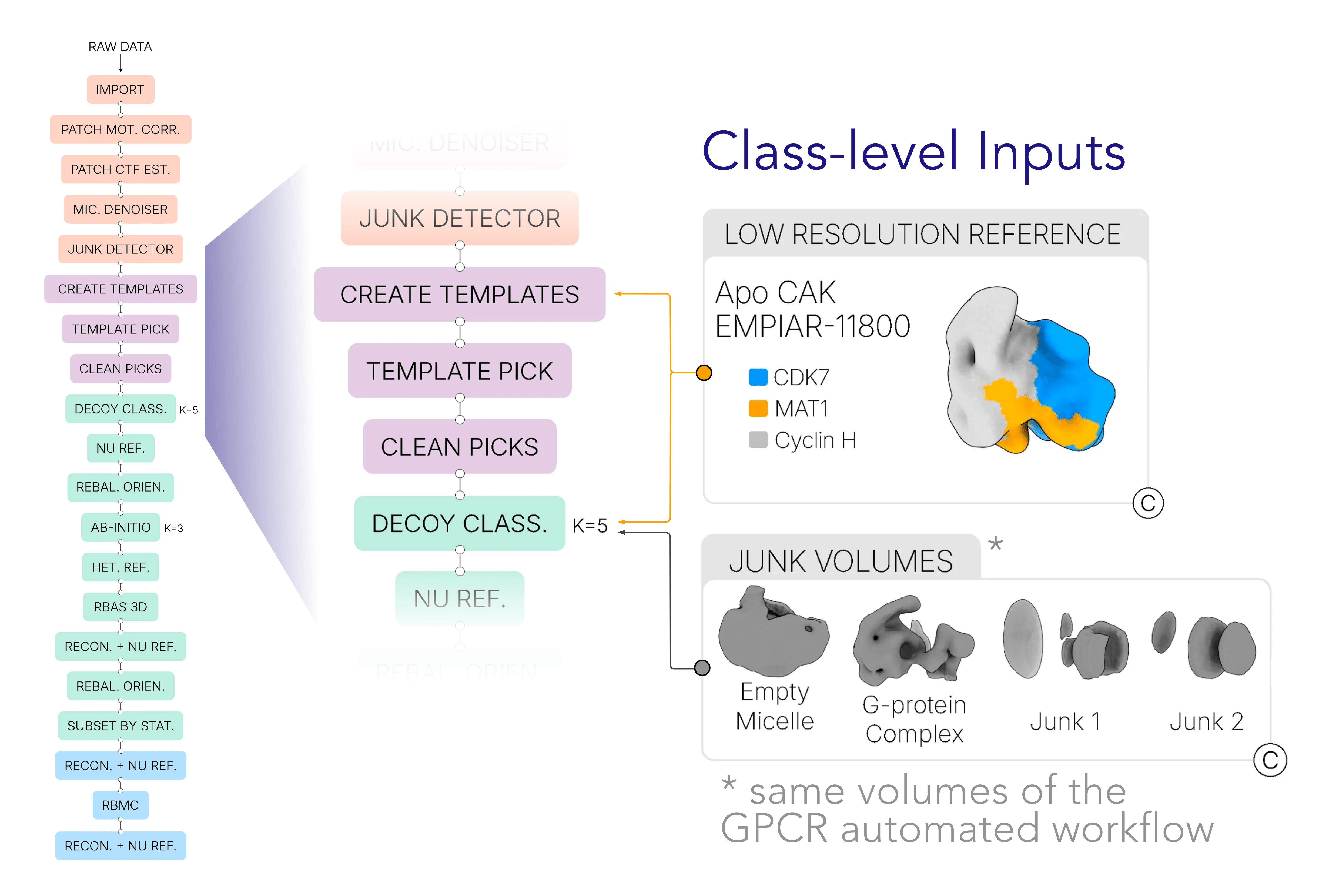
The severe preferred orientation in the CAK datasets made it challenging to rely on Blob Picker to generate templates, as rare particle views could be missed during the initial picking. Using the imported reference volume to generate templates allowed the workflow to explicitly include rare views during Template Picking, increasing the chances of recovering particles from under-represented orientations.
Notably, the particle cleanup step did not require new junk volumes: the same junk volumes developed for the original GPCR automated workflow (v1) were reused for decoy classification of the CAK datasets. By performing particle curation directly in 3D, decoy classification also helps preserve rare views that might otherwise be lost during 2D Classification, making it particularly useful for datasets affected by preferred orientation.
Rebalance Orientations: Sometimes Less is More
Even after using Template Picker and decoy classification to recover as many rare views as possible, the CAK datasets still presented strongly unbalanced orientation distributions. Rebalance Orientations provided an additional strategy to address preferred orientation, complementing the improvements achieved during particle picking and curation.
Rebalance Orientations works by discarding a fraction of particles from over-represented orientations, producing a more balanced particle stack. When enough particles remain to support a high-resolution reconstruction, sacrificing some particles from the dominant views can improve map isotropy and interpretability, even though the total number of particles is reduced.
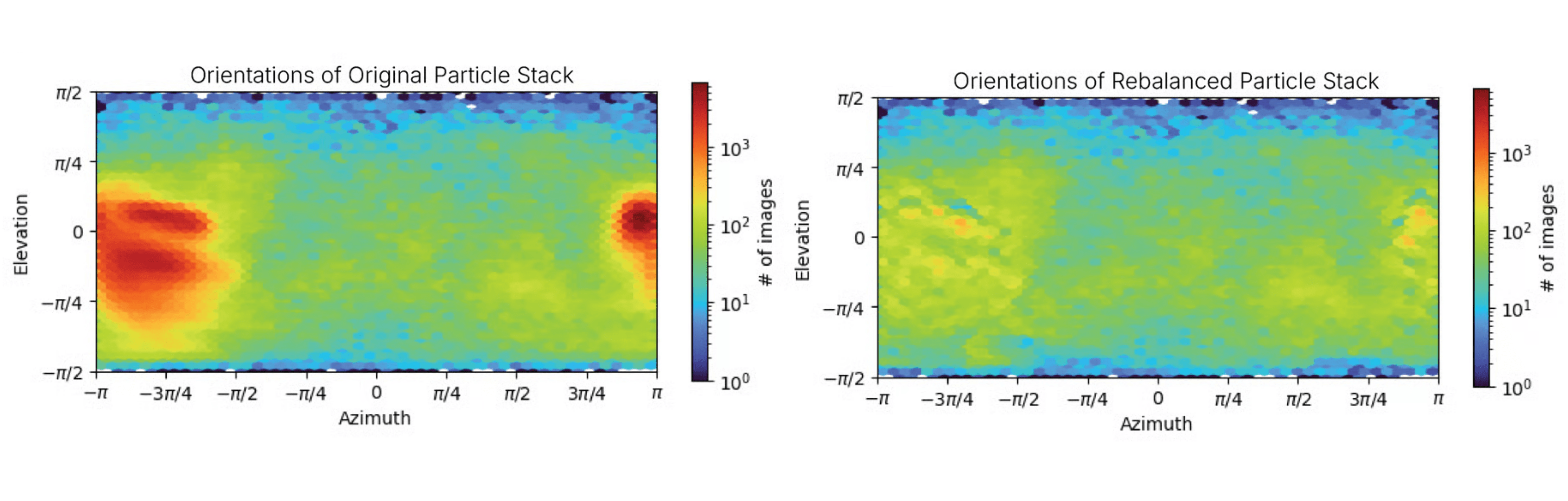
The Rebalance percentile parameter can be adjusted according to the severity of preferred orientation, controlling how aggressively overrepresented views are pruned.
Subset by Statistics: Selecting Higher-Quality Particles
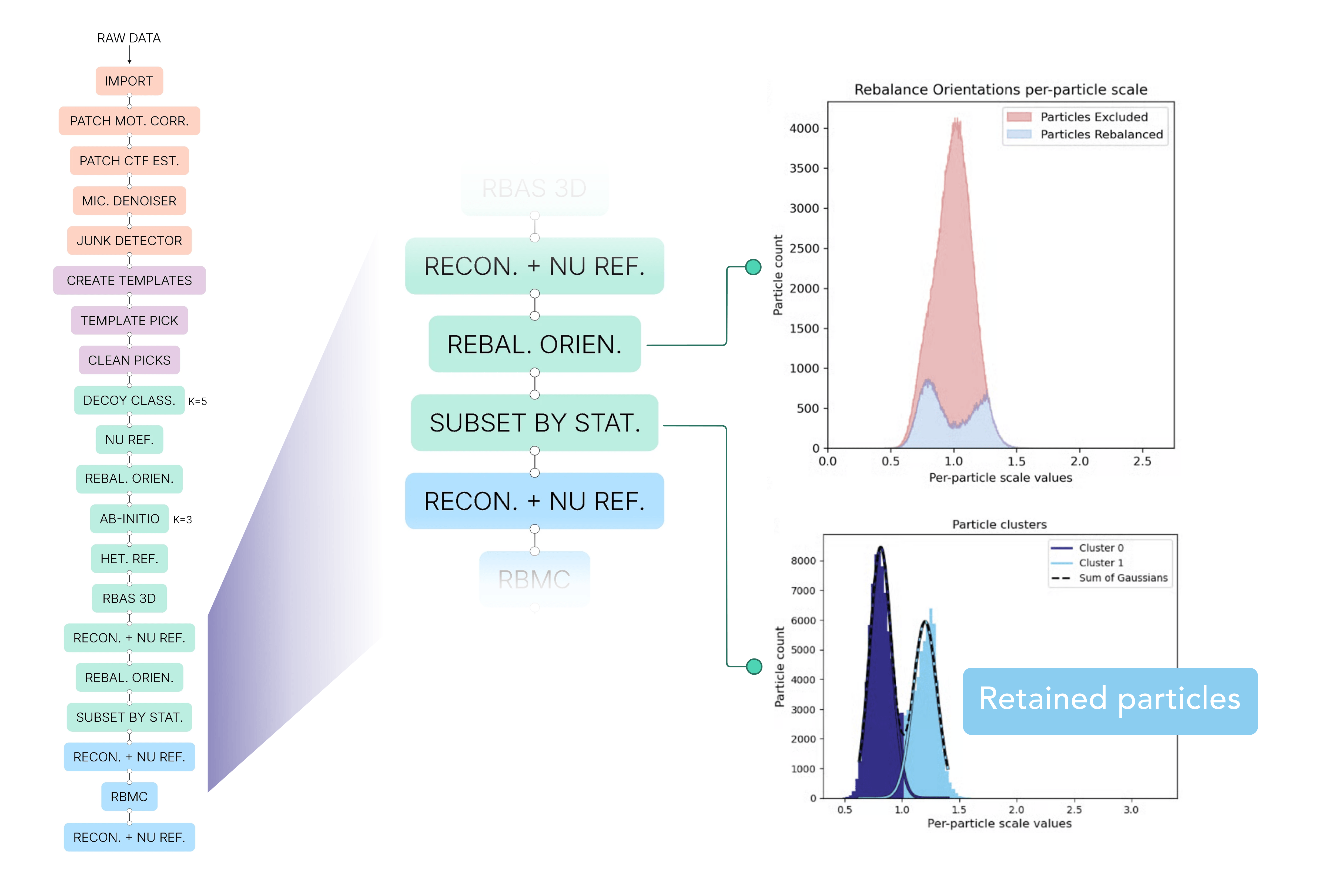
In the CAK datasets, after rebalancing orientations, a bimodal distribution of per-particle scale values was observed once the over represented views were removed, highlighting the presence of two particle populations with different scale values. Subset Particles by Statistic was then used to remove particles belonging to the low-scale population, retaining the high-scale cluster for further refinement, since, in this case, it corresponded to the good particles.
The Updated Automated Workflow: Workflow v2
Once again, automation in CryoSPARC demonstrated its robustness and generalizability, achieving results matching or exceeding manual processing even for small, drug-bound particles affected by severe preferred orientation. By isolating smaller, higher-quality particle stacks, automated curation helped mitigate the effects of preferred orientation, improving map quality and interpretability. Improved cFAR scores across all nine datasets reflected these gains, with ligand densities generally comparable to or better resolved than in the deposited maps. Improved map-model metrics further supported the quality of the automated reconstructions.
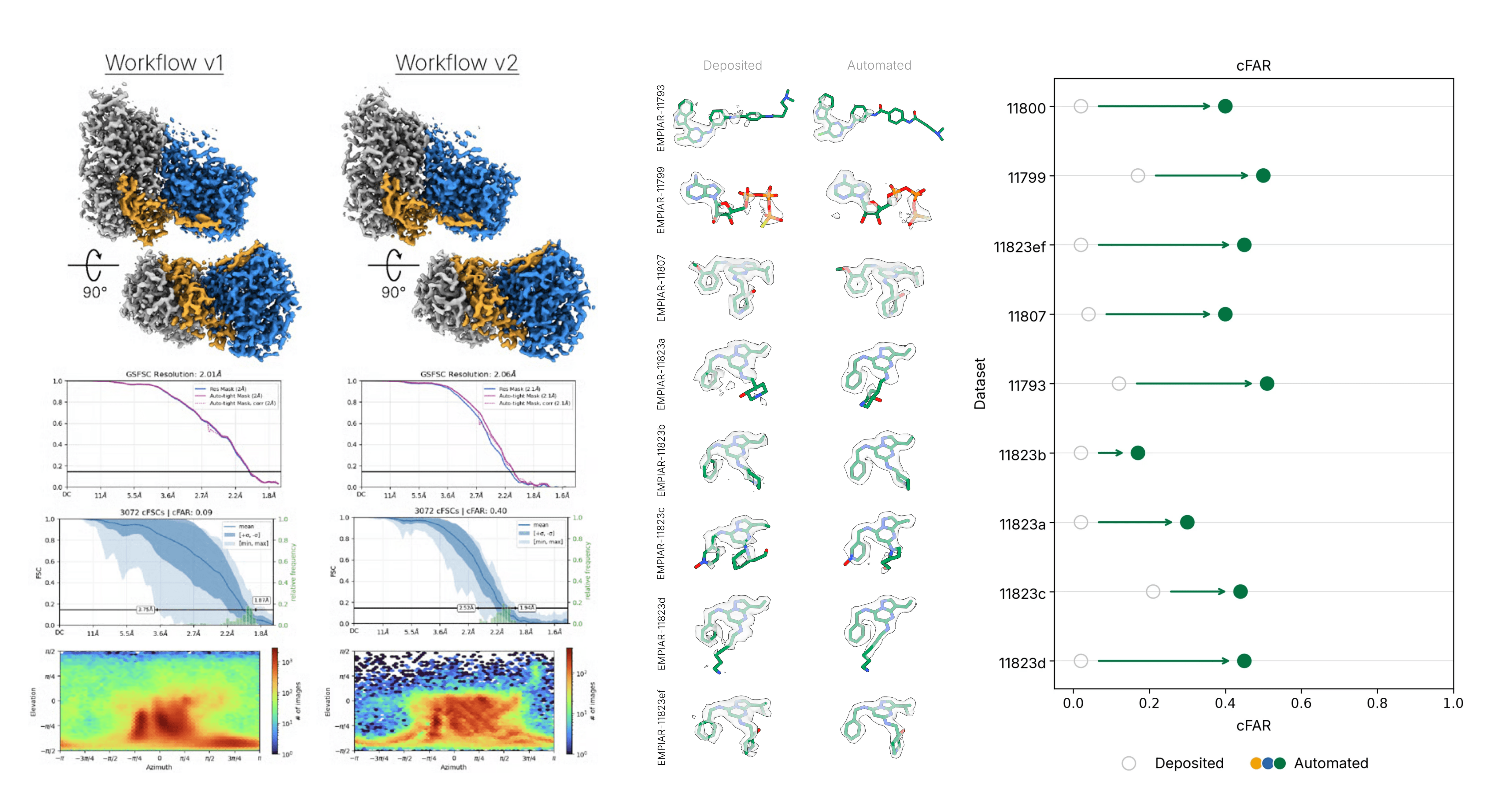
With end-to-end processing times averaging less than 24 hours, combining CryoSPARC Live preprocessing with parallel automated workflows could make it feasible to collect and process a fully loaded 12-grid autoloader within just a few days.
The automated workflow in CryoSPARC can be easily implemented and adapted to different types of targets by adjusting key parameters and inputs at the target, class, and workflow levels.
With the challenge of severe preferred orientation successfully addressed, these advances further increase the scalability and throughput of cryo-EM data processing, making high-quality results more accessible to both new and experienced practitioners and supporting downstream biological research and drug discovery.
While this work demonstrates what is already achievable with automated cryo-EM processing, development at Structura Biotechnology continues toward workflows capable of tackling new challenges, including structural heterogeneity. Stay tuned for more updates!